
Towns That Turned It Around, part 1
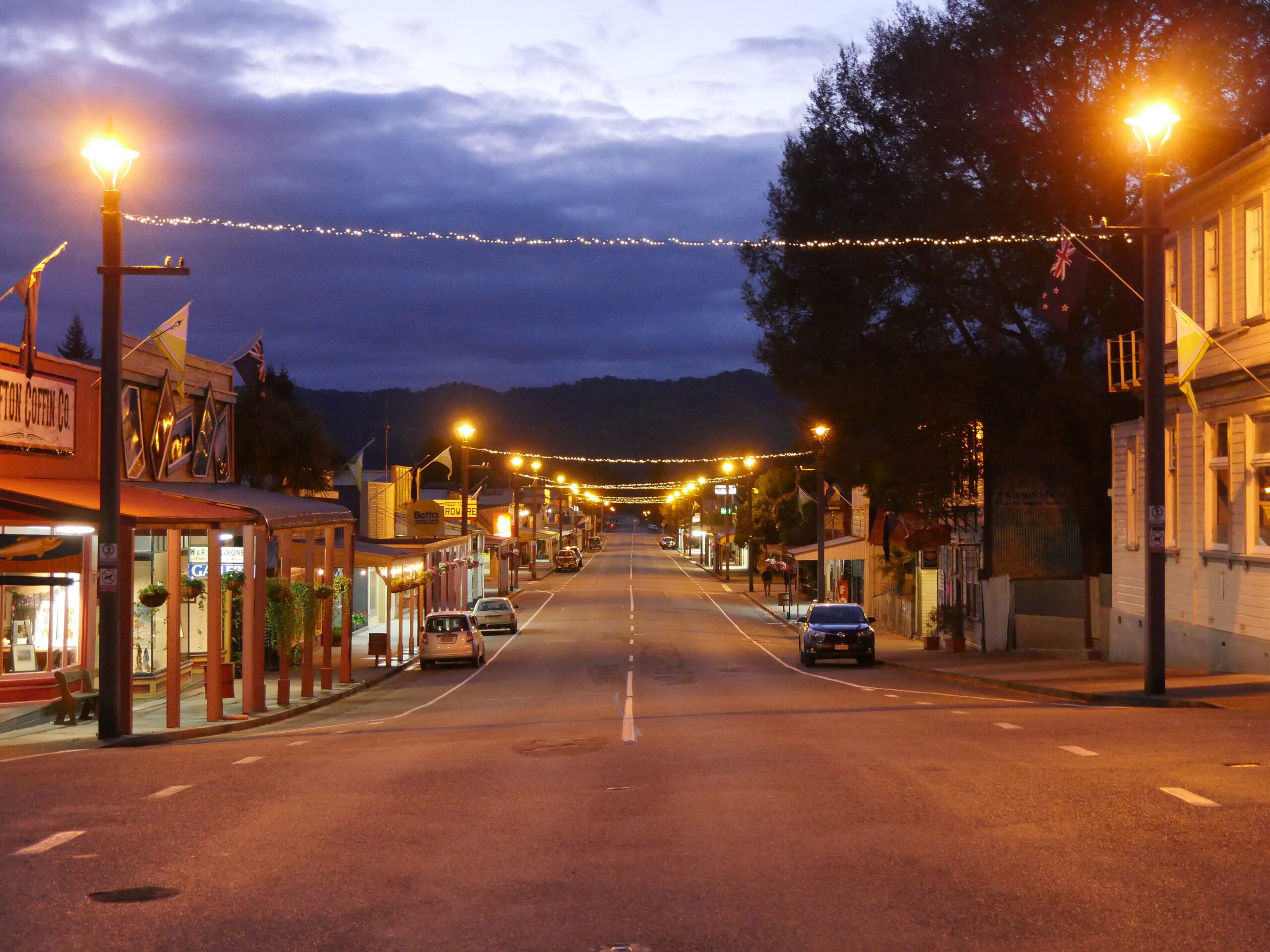
Picture a main street of old timber shopfronts, bush-covered hills behind, and old-fashioned lamps glowing along the footpath at dusk. That is Reefton, a town of about a thousand people in the Inangahua valley on the West Coast of New Zealand’s South Island. It lived and nearly died by gold, and then worked out how to live off its own story. It is the first stop in our series on small places that turned themselves around, and there is a lot in it for a canal and bog town in the Midlands.
Where it started
Alluvial gold turned up in the Inangahua valley in 1866, but the real prize came in 1870 with gold-bearing quartz reefs, and by 1872 gold was being taken out. The settlement was first called Reeftown, nicknamed Quartzopolis, and its main street was named Broadway after an early magistrate, Charles Broad.
Then came the moment Reefton still dines out on. In November 1886 an English electrical engineer, Walter Prince, lit up four hotels on Broadway with a small dynamo. Within weeks, 65 local residents had formed a company to build a hydro-electric station on the Inangahua River. It began supplying the town on 4 August 1888. Heritage New Zealand describes it as the first public supply of electricity in the southern hemisphere, and Reefton has called itself the Town of Light ever since. Householders paid £1 to be connected and £3 a year for every light, and by Christmas 1888 there were about 500 bulbs burning.
The good times did not last. Between 1872 and 1951 the district’s 59 mines produced 64,700 kilograms of gold, but by 1951 every one of them had closed. Coal and forestry took up some of the slack. The old power station ran until 1946, when a flood damaged its water race and the town switched to the grid, and the building was knocked down in 1961.
What changed and who drove it
Reefton did not get one big rescue. It got a string of locally driven projects that all pull in the same direction: heritage, the outdoors and a reason to stop.
The streetscape. Broadway’s restored buildings now hold galleries, gift shops, cafés, pubs and second-hand shops. There is a self-guided history walk past the old School of Mines, banks, churches, the Oddfellows Hall and the courthouse, and at night the street is lit by heritage-style lamps. The town has made its main street the attraction rather than just the road through.
The powerhouse, rebuilt by the community. For decades the old power station site was overgrown, by the trust’s own account covered in gorse and broom. In 2002, after what the Reefton Powerhouse Charitable Trust calls “a beer too many”, its members started planning a full rebuild of the hydro scheme. They restored the original intake, water race and tunnels, bought the land, and installed a modern turbine from Sweden. In January 2026 The Press reported the scheme was back feeding the national grid and earning about NZ$200,000 a year for the trust. Along the way they upgraded the Powerhouse Walk, added new bridges, interpretation panels and replica 1888 street lamps, and opened a 17-hectare recreation area. It took 24 years.
A distillery owned by the town. Reefton Distilling Co. was set up by Patsy Bass and Sean Whitaker. Rather than chase one big backer, they ran a public equity crowdfunding offer and raised NZ$1.385 million from 221 investors, many of them locals and West Coasters. A major shareholder offered a run-down heritage building, a former general store on Smith Street, and it was restored as a working distillery, tasting bar and shop. It opened on 17 October 2018. Its foundation shareholders’ page thanks those who backed “a gutsy little West Coast distillery” to create jobs and a tourist attraction.
The bush on the doorstep. Reefton sits beside Victoria Forest Park, which the West Coast tourism body describes as the largest forest park in New Zealand. The Department of Conservation looks after a network of walking and mountain bike tracks built on old pack tracks, tramlines and mining roads. The Murray Creek track starts at Blacks Point, two kilometres from town, and links up to a popular ride of about five hours. Further out, Waiuta, a gold town abandoned in 1951, is now a protected ghost town in the care of DOC, a few residents and a volunteer group, the Friends of Waiuta. Mining relics are a big part of the draw on all of these.
How it was paid for
The powerhouse is the best example of patient, layered funding. Newsroom reported in 2023 that Development West Coast, a regional development trust, gave a NZ$170,000 suspensory loan to buy the forestry land. In 2011 a Buller District Council fund granted NZ$400,000 on condition the trust matched it, which it did. The big step was NZ$2.87 million from the Lottery Grants Board’s significant projects fund, plus NZ$250,000 from the Lottery Environment and Heritage fund. Local contractors worked at “mates’ rates” and donations came in from around the country. The total came to about NZ$3.9 million, including in-kind support from businesses.
The distillery was paid for by the people who would drink in it. The crowdfunding offer had a minimum target of just over NZ$1 million, which it passed, before it closed at NZ$1.385 million.
What worked and what didn’t
What worked was owning the story. Reefton had one genuinely remarkable fact, the 1888 lights, and it built a whole identity around it, from the nickname to the replica lamps to a working power station you can walk to from the visitor centre. Projects were broken into manageable stages, and each one gave funders something real to back.
What didn’t work so well was leaning on mining. A modern open-cast gold mine ran near the town from 2006 to early 2016 and employed up to 300 people. When it closed, five staff were left. Booms like that can lift a town for a decade and then drop it. The powerhouse also shows the cost of going slowly: Covid hit mid-build, some costs more than doubled, and the trust needed land deals, several consents and plenty of stubbornness to get there.
Lessons for a small Irish town
- Find your one true story and stick to it. Reefton’s is electric light. Every town has something.
- Make the main street the destination. Restored shopfronts, decent lighting and a walking trail cost less than a new attraction and help every business.
- Let locals own a piece of it. A community share offer gave the distillery 221 backers who want it to succeed.
- Stack small funders before big ones. Local and regional money unlocked the national lottery grant.
- Link town and landscape. Trails that start on the main street bring walkers and cyclists into the cafés.
Could Daingean do this?
- What is Daingean’s “1888 lights” moment, the one story nobody else can tell, and how could we put it on the street where visitors see it?
- Could a community share offer, like Reefton’s distillery, fund a local business or attraction here? What would people be willing to invest in?
- The Grand Canal and the bogs are our version of Victoria Forest Park. What would it take to make walkers and cyclists stop in the village instead of passing through?
Join the conversation on the Brainstorm Daingean forum. Tell us what you think, and add your own ideas.
Sources
- Te Ara, the Encyclopedia of New Zealand, “West Coast places: Reefton” (Simon Nathan, 2009)
- Heritage New Zealand, “Reefton Power House Foundations”, List no. 5002
- Engineering New Zealand, “Reefton Power Station” heritage record
- Electricity Engineers’ Association, “History of our industry”
- Tohu Whenua, “Historic Reefton”
- Newsroom, “Reefton turns the lights on again” (7 March 2023)
- The Press, “New Zealand’s first power station roaring once again after 80 years” (25 January 2026)
- Energy Excellence Awards, “Awards finalist: Reefton Powerhouse Charitable Trust” (22 July 2026)
- NZBusiness, “Crafting untamed spirits”
- Scoop, “Successful capital raise for new West Coast business” (February 2018)
- Reefton Distilling Co., “Foundation Shareholders”
- Otago Daily Times, “Oceana to close Reefton mine” (19 December 2016)
- Department of Conservation, Victoria Forest Park tracks (Murray Creek, Waitahu to Murray connecting track)
- West Coast NZ, “Reefton walks”
- Featured photo: “Reefton, New Zealand (by night)” by Ulrich Lange, CC BY 3.0, via Wikimedia Commons
No reviews yet.